About Me
Research Postions:
(2025-present): Postdoctoral Research Associate at NOIRLab
Education:
(2021 - 2025): PhD at University of Edinburgh (Supervisors: James Dunlop, Ross McLure, Derek McLeod)
(2016 - 2021): MPhys (1st class) at University of St Andrews (Supervisor: Rita Tojeiro)
Research Interests: First galaxies, cosmic reionization, galaxy formation and evolution, large-scale structure
Publications:
Donnan, C.T., McLeod D. J., McLure R. J., et al., (2026), ApJ : “Spectroscopic Confirmation of a Large and Luminous Galaxy with Weak Emission Lines at z = 13.53”
Donnan, C.T., Dickinson M., Taylor A. J., et al., (2025), ApJ : “Very Bright, Very Blue, and Very Red: JWST CAPERS Analysis of Highly Luminous Galaxies with Extreme Ultraviolet Slopes at z = 10”
Donnan, C.T., Dunlop J. S., McLure R. J., et al., (2025), MNRAS : “No evidence (yet) for increased star-formation efficiency at early times”
Donnan, C.T., McLure R. J., Dunlop J. S., et al., (2024), MNRAS : “JWST PRIMER: A new multi-field determination of the evolving galaxy UV luminosity function at redshifts z=9-15”
Donnan, C.T., McLeod D. J., McLure R. J., et al., (2023), MNRAS : “The abundance of z>10 galaxy candidates in the HUDF using deep JWST NIRCam medium-band imaging.”
Donnan, C.T., McLeod D. J., Dunlop J. S., et al., (2023), MNRAS : “The evolution of the galaxy UV luminosity function at redshifts z=8-15 from deep JWST and ground-based near-infrared imaging.”
Donnan C.T., Tojeiro R., Kraljic, K., 2022, Nature Astronomy : “The role of the cosmic web in the scatter of the galaxy mass-metallicity relation”
A full list can be found here.
Research
The First Galaxies
I use a mix of primarily JWST NIRCam and NIRSpec surveys to understand the formation and evolution of the first population of galaxies.
In Donnan et al. (2023a,b,2024) I use JWST/NIRCam imaging to reveal
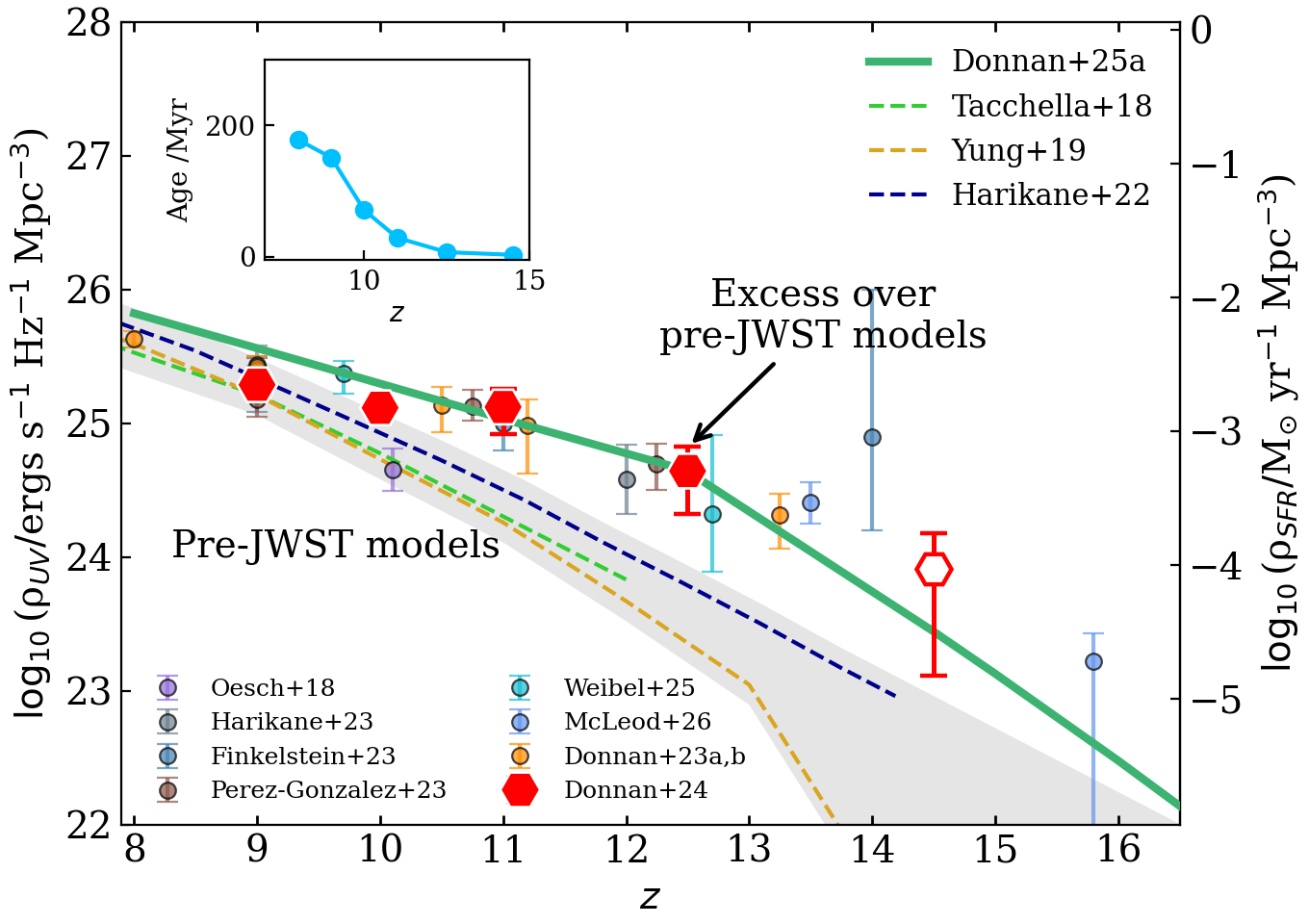
a slow evolution in the UV LF in excess of a number of pre-JWST theoretical models.
In Donnan et al. (2025a) I construct a simple theoretical model that demonstrates that a constant
star-formation efficiency with decreasing mass-to-light ratios as a function of redshift, is sufficient to model both the galaxy stellar mass function (GSMF)
and UV LF. A natural prediction of this model is a more rapid decline in the UV LF at z>13 which is now supported by recent wide-area UV LF studies (McLeod et al. 2026, Weibel et al. 2026).
In Donnan et al. (2025b) I present JWST/NIRSpec spectra from the CAPERS program of three
galaxies with extreme UV slopes. Two of these sources have very blue UV slopes and are a close pair of merging galaxies. The extreme UV slopes imply strong escape of
ionizing Lyman-continuum radiation. In contrast, we present a red galaxy at z=10 where the red UV slope may be driven by significant dust-attenuation implying an extreme intrinsic
UV magnitude.
In Donnan et al. (2026) I present JWST/NIRSpec follow-up of a z=15 candidate PAN-z14-1 which
we spectroscopically confirm to be z=13.53. This galaxy presents remarkably "normal" properties with a blue but not extreme UV slope, extended morphology and
lack of strong UV emission lines.
Galaxy Evolution in the Cosmic Web
On the largest scales, galaxies are distributed into a web-like structure of dense nodes connected by filaments and separated by vast voids.
Using the large spectroscopic galaxy survey SDSS as well as the cosmo-hydro simulation Illustris TNG, I explored the link between how galaxies evolve and their position relative to features of this large-scale structure.
We showed that galaxies, independent of overdensity and stellar mass, have higher gas-phase metallicities close to nodes with a weaker relationship present with filaments.
This work has been published in Nature Astronomy.
Contact
Email: callum.donnan@noirlab.edu
Address: NOIRLab,
950 N Cherry Ave,
Tucson, Az,
85719